

Understanding the psychology of problem-solving can help us approach challenges differently.
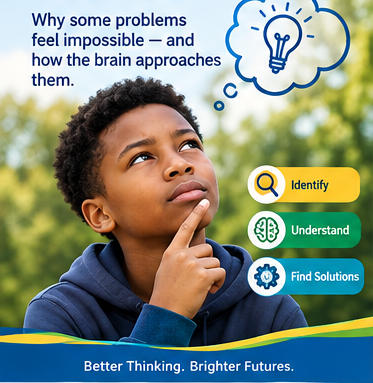
Problems are part of everyday life. A learner may struggle to understand a difficult question. A parent may not know how to support a child who is falling behind. A young person may be unsure how to respond to conflict with a friend. An adult may face a problem at work or home or in a relationship. Some problems seem easy to solve. Others can leave us feeling overwhelmed, frustrated or completely stuck. What actually happens in our minds when we try to solve a problem?
What Is Problem-solving?
Problem-solving can be described as a process of identifying a challenge, understanding what is happening, generating possible solutions, choosing an approach and taking action. One can argue that it is not simply about being "clever” but it involves several psychological processes such as attention, memory, reasoning, creativity, decision-making and self-regulation. This is important to note because people can struggle with a problem for many different reasons. Sometimes the problem itself is difficult, or we have not understood it properly. And sometimes our emotions, assumptions or previous experiences influence the way we approach it.
4 Recommended problem-solving steps
There are no fixed steps for problem-solving. If there were, many people would just use those steps and easily solve problems. I believe it is important to get to the root cause of each problem and these are common steps that I recommend:
Step 1: Identify the problem
The first step is surprisingly easy to overlook; we need to ask: "What exactly is the problem?" Imagine a learner who says: "I'm bad at mathematics." That statement describes a feeling or belief, but it does not identify the actual problem.
The underlying problem might be that the learner:
- does not understand fractions;
- struggles to remember mathematical procedures;
- reads questions too quickly;
- becomes anxious during tests;
- has missed important foundational concepts.
Each of these problems requires a different response. This is why identifying the real problem matters.
Step 2: Understand the problem
Once we identify a problem, we need to understand it. This step slows down our thinking and helps us move from reacting and trying random solutions. We have to start with understanding what we are dealing with. Ask:
- What is happening?
- When does it happen?
- What might be causing it?
- What information do I have?
- What information am I missing?
- What have I already tried?
Step 3: Break the problem down
Problems can feel overwhelming as we try to force the brain to deal with too much or a lack of information and come up with solutions. Breaking a problem into smaller parts can make it more manageable. Obviously, the problem will not vanish or become smaller, but it can become clearer. For example:
Problem: "I have too much schoolwork." Instead of treating it as one enormous problem, break it down:
- Which assignments are due first?
- Which assignments will take the longest?
- Which tasks can be completed quickly?
- Which tasks require help?
- When can each task be completed?
- What information do I still need?
Step 4: Generate possible solutions
Good problem-solvers do not necessarily find the perfect answer immediately. They generate possibilities, which is where creativity becomes important. The goal is to create possibilities before deciding which one is most appropriate. Start by asking: "What could I try?"
A learner struggling with studying might consider:
- studying in shorter sessions;
- using flashcards;
- practising retrieval;
- explaining the topic aloud;
- studying with a friend;
- changing the study environment;
- asking the teacher for clarification.
Shaped by Psychology Perspective
Problem-solving is not simply a school skill. It is a life skill. The way we approach problems is influenced by how we think, what we remember, what we believe and how we manage our emotions. That means problem-solving can be developed. The next question is: “If we know how to solve problems, why do we sometimes get stuck?”
That is where psychology becomes even more interesting.