

The answer is yes!
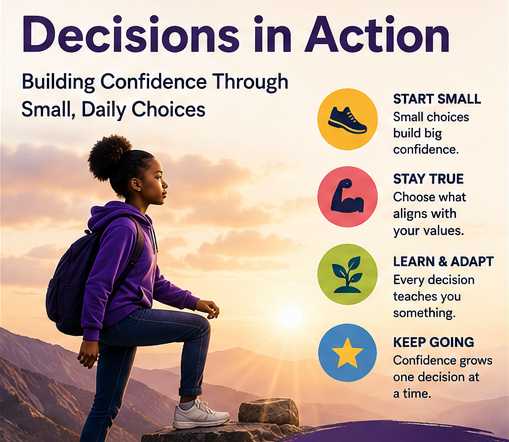
We have explored how our decisions can be influenced by our emotions, experiences, beliefs, relationships, social pressure and mental shortcuts.
But knowing that these influences exist is only the beginning. Becoming better at decision-making means learning to make more conscious, informed, and reflective choices.
THE 5-QUESTION DECISION CHECK
When you face an important decision, try asking yourself these five questions:
- What exactly am I deciding? Many decisions are poorly defined. The clearer the decision, the easier it becomes to evaluate your options.
- What do I actually know? Separate facts from assumptions. Ask yourself whether the decision is based on a fact. Or is it an assumption based on something you have heard? Good decision-making requires examining the information behind our conclusions.
- What emotions are influencing me? Before making an important decision, check in with yourself. Are you: Afraid? Angry? Excited? Pressured? Desperate? Overwhelmed? Eager for approval? You don't need to eliminate the emotion. Simply recognising it can help you create psychological space between feeling something and acting on emotions. Remember, sometimes a pause is exactly what a decision needs.
- What matters to me? Your values matter and when options are complicated, values can act as a compass.
- Who else is affected? This is where we bring the Afriwesternism lens into our decision-making framework. An individual perspective may ask: “What is best for me?” A relational perspective adds: “How might this decision affect others?” This is especially relevant when decisions involve family, work, education or community. The point isn't to allow everyone else to make your decisions for you. It is to recognise that our choices can have consequences for the people connected to us.
GOOD DECISIONS DON’T GUARANTEE GOOD OUTCOMES
There is another lesson we need to understand. Sometimes we make a thoughtful decision and things still go wrong. You can gather information. Think carefully. Consider your emotions. Consult others. Evaluate the risks. And still experience an unexpected outcome. That's because decision-making happens under uncertainty. So we shouldn't judge every decision purely by what happened afterwards. Instead, ask:
- Did I use the information available to me?
- Did I consider the alternatives?
- Did I recognise my emotions?
- Did I consider my values?
- Did I think about the consequences?
- Did I make the decision consciously?
If the answer is yes, you may have made a good decision, even if the outcome wasn't what you hoped for.
DECISION-MAKING IS A SKILL
The good news is that decision-making can be developed. We can learn to:
- pause before reacting;
- identify psychological influences;
- distinguish facts from assumptions;
- consider alternatives;
- recognise our biases;
- clarify our values;
- evaluate consequences;
- seek appropriate advice;
- and reflect on our decisions afterwards.
We don't become better decision-makers by never making mistakes. We become better decision-makers by learning from our decisions.
FROM INFORMATION TO INFORMED ACTION
This is particularly important in education and career development. Giving a learner information about careers is useful. But information alone doesn't guarantee a good decision. A learner may need help understanding:
- Who am I?
- What matters to me?
- What are my strengths?
- What influences my choices?
- What options are realistic?
- What are the consequences of each pathway?
- Who else should be part of the conversation?
This is where psychology-informed guidance can move beyond simply giving people information. It helps them develop the capacity to understand, evaluate and act.
WHERE VMC CONSULTANCY COMES IN
This is what VMC Consultancy is ultimately about. We believe that many real-world challenges require more than information. They require solutions that understand people. Our psychology-informed approach begins with understanding the challenge before jumping to the solution. This approach can be applied across education, career development, learning, organisational development and other areas where human behaviour matters. Sometimes the solution isn't simply giving more information; it is helping people understand what to do with the information they have.
Psychology gives us tools for understanding human behaviour. African perspectives bring valuable insights about relationships, community and interconnectedness. Afriwesternism creates space for these perspectives to meet. The result is not about choosing between “African” and “Western.”
REMEMBER: YOUR DECISION-MAKING CHALLENGE
The next time you face an important decision, stop and write down the answers to these five questions:
- 🧠 What exactly am I deciding?
- 🔎 What do I actually know?
- ❤️ What emotions are influencing me?
- ⭐ What matters to me?
- 🌍 Who else is affected?
Don't rush to the answer. Better decisions start with better understanding.
If your school, organisation or programme is facing a learning, career or development challenge, VMC Consultancy can help you explore a psychology-informed, practical solution.