

Decision-making isn't just logic. Our decisions are shaped by much more than the options in front of us.
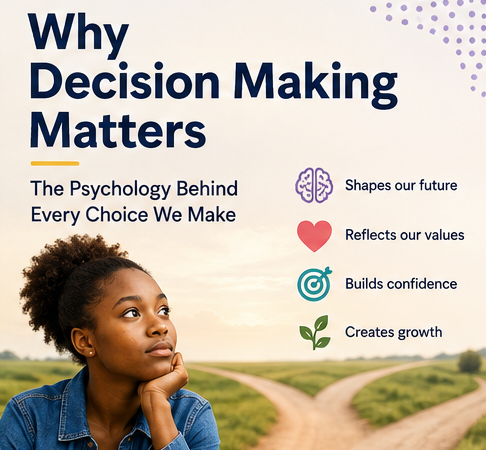
Every day, we make decisions. Some are so mundane that we barely notice them, such as:
- What should I eat?
- What should I wear?
- Should I answer this message?
- Should I take this route?
Then some decisions can change the direction of our lives:
- What should I study?
- Which career should I pursue?
- Should I accept this job?
- Should I start a business?
- Should I move?
- Should I end this relationship?
We like to think that we make decisions logically. We gather information, compare our options and choose what appears to be the best one. Sometimes we do. But human decision-making is influenced by our thoughts, emotions, memories, experiences, beliefs, values and social environment. Meaning that our psychological interpretation is diverse.
This means that two people can face the same situation and make completely different decisions. Why? Because they aren't bringing the same psychological experiences to the decision. One person may see an opportunity. Another may see a risk. One may feel excited. Another may feel afraid. One may think, “This is exactly what I've been waiting for.” Another may think, “This could go terribly wrong.” Even though the situation is the same.
YOUR BRAIN USES SHORTCUTS
Have you ever chosen something simply because it was familiar? Perhaps you're shopping and see two products. One is a brand you've used for years. The other is cheaper, but you've never heard of it. You may immediately choose the familiar brand. You haven't necessarily compared every feature. Your brain has used a shortcut, which is often referred to as heuristics or “rule of thumb”.
Heuristics allow us to make decisions quickly without analysing every possible piece of information. And that's useful. Imagine having to analyse every decision you make during a normal day carefully. You'd be mentally exhausted before lunchtime. Our brains therefore use shortcuts to help us function efficiently. Using shortcuts can be a challenge if it leads us to inaccurate conclusions. In essence, a shortcut that works well in one situation may not work well in another.
EXPERIENCE BECOMES PART OF THE DECISION
Our previous experiences also influence the choices we make. Imagine someone who was betrayed by a close friend. Years later, they meet someone new but whose behaviour is similar to the betrayer. The person's previous experience may make them cautious. Although caution might protect this person, it could also cause him/her to judge the new person based on what happened in the past. This is an important psychological distinction: Our past can inform our decisions without controlling them. Experience can teach us. But sometimes we need to ask whether the lesson we learned yesterday actually applies to the situation we are facing today.
WE DON’T MAKE DECISIONS IN A VACUUM
There is another factor we often underestimate: other people. Our decisions can be influenced by parents, friends, partners, teachers, colleagues, communities and wider social expectations. Oftentimes, we aren't asking: “What do I want?” We're unconsciously asking: “What will people think if I choose this?”
Those are two very different questions. This becomes particularly important when decisions involve education, careers, relationships and major life choices.
A young person may want one career while their family strongly prefers another. An employee may want to change careers but fear disappointing their colleagues. A person may want to start a business but worry about what others will say if it fails. The decision may appear personal. But the psychology surrounding it can be deeply social.
ARE OUR DECISIONS REALLY OUR OWN?
Yes and no. We do have the ability to make choices. But our choices emerge from everything we bring into the situation: our minds, emotions, experiences, relationships, beliefs, values and environment. Understanding this doesn't mean we have no control. It means we can become more aware of the forces influencing our choices. And that awareness is important. Because before we can improve our decisions, we first need to understand how our decisions are being shaped.
So, the next time you make an important decision, pause before asking:
“What should I choose?” Ask: “What is influencing the way I am looking at this choice?”
That one question can change the way you approach a decision. And it leads us to the next part of our conversation.